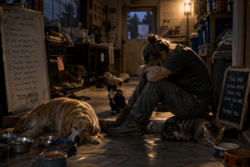
There are days in rescue work when the math simply does not work. It doesn’t matter what kind of animal you’re rescuing. Dogs. Cats. Parrots. Reptiles. It makes no difference. The math is the same:
There are more animals than hands.
More needs than hours.
More responsibility than one person should ever be asked to carry.
And still—the food has to be served.
The water has to be changed.
The sick have to be treated.
The frightened have to be reassured.
There is no pause button. There is no “I’ll get to it tomorrow” for the things that keep living beings alive.
And when volunteers don’t show up, or emergencies stack on top of an already full day, it doesn’t just get busy.
It becomes impossible.
The Trap That Breaks Good People
This is where many rescuers begin to break—not because they don’t care, but because they care too much.
They try to do everything anyway.
They skip meals.
They ignore their own pain.
They push through exhaustion.
They tell themselves, “Just get through today.”
And when the day ends and not everything is done, they feel like they’ve failed.
But this is the truth:
You did not fail. The situation was never possible to begin with.
This Is Not a Time Management Problem
Most advice will tell you to “manage your time better.”
But this isn’t about time.
This is about load.
You cannot fit ten hours of work into five, no matter how organized you are.
You cannot carry the weight of three people with one body, no matter how dedicated you feel.
So the question has to change.
Not:
“How do I get everything done?”
But:
“What must be carried today, and what can wait without harm?”
The Triage Mindset
In rescue work, we already understand triage when it comes to animals.
We need to apply that same thinking to our workload.
Must happen today:
- Food
- Water
- Medication
- Safety
These are non-negotiable.
Should happen soon:
- Cleaning
- Enrichment
- Routine maintenance
Important—but survivable if delayed.
Can wait:
- Non-critical projects
- Administrative tasks
- The things that make everything “nice,” but not necessary
When everything feels urgent, nothing can be prioritized.
Triage gives you permission to choose.
Something Will Be Left Undone
This is the part no one likes to say out loud.
If there is more work than time, something will not get done.
That is not a failure of character.
That is not a lack of dedication.
That is math.
You are not failing the animals by having limits.
You are honoring reality so that you can continue to care for them tomorrow.
Protect the Caregiver
This is the hardest lesson, especially for those who give everything they have.
If you collapse, everything stops.
Skipping your own needs is not noble.
It is not sustainable.
And it does not serve the animals in the long run.
Eat something.
Take your medication.
Sit down for five minutes.
You are not separate from the system you are holding together.
You are a critical part of it.
Build Systems That Catch You When You’re Tired
You will have days when you are running on empty.
Plan for those days before they happen.
- Set routines that don’t require thinking
- Prepare what you can ahead of time
- Use reminders, lists, or automation where possible
These are not shortcuts.
They are supports.
You Are Allowed to Be Human
There is a quiet guilt in rescue work.
A feeling that if you care enough, you should be able to do it all.
But caring does not remove limits.
It only makes those limits harder to accept.
So hear this clearly:
You are allowed to have limits.
Do what must be done.
Do it well.
Let the rest wait.
And do not punish yourself for limits you did not create.
There will always be more work than time in rescue.
The goal is not to solve that.
The goal is to carry what matters—
without breaking under the weight of it.